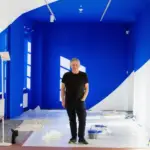






The Felice Varini exhibition at the Museo d’arte Mendrisio is approaching its final days after attracting an impressive number of visitors. Open until 11 October 2026, the exhibition is celebrating its success with an important announcement: the iconic artwork Ellisse Blu will become part of the museum’s permanent collection.
There are only a few days left to visit the major solo exhibition dedicated to Felice Varini, one of Switzerland’s most internationally recognised contemporary artists. Hosted at the Museo d’arte Mendrisio, the exhibition will close on Sunday, 11 October 2026, following a remarkable journey through painting, architecture and visual perception that has captivated visitors of all ages.
With an average of 600 visitors per week, hundreds of guided tours for groups and schools, and an exhibition catalogue that is almost sold out at the museum bookshop, the event is coming to an end on a particularly positive note.
Adding to its significance is the announcement that Ellisse Blu, one of the exhibition’s most recognisable works, will be donated to the museum, becoming a lasting part of its artistic heritage.
Ellisse Blu: an artwork that will remain in Mendrisio
The donation of Ellisse Blu is one of the most important developments to emerge from the exhibition.
The artwork, which has become one of the defining images of the show, will officially join the collections of the Museo d’arte Mendrisio, strengthening the connection between the artist and the cultural institution.
Museum director Barbara Paltenghi Malacrida, who curated the exhibition alongside Felice Varini and Francesca Bernasconi, expressed great satisfaction with the results achieved.
The project presented significant challenges in terms of curation and exhibition design, but the public response exceeded expectations, confirming the strong interest in innovative artistic experiences.
The future location of Ellisse Blu has yet to be decided. The work may be displayed inside the museum or in another public space in the City of Mendrisio.
Either way, the donation represents an important legacy, ensuring that a tangible reminder of this exhibition will remain in Mendrisio long after its conclusion.
An exhibition that transforms architecture into art
The exhibition in Mendrisio is Felice Varini’s first solo exhibition in a Swiss museum, a project that extends throughout the entire museum complex through painted interventions created in close dialogue with the architecture.
The exhibition begins in the 15th-century cloister of the former San Giovanni complex, home to the museum, before continuing through the interior galleries, which have been transformed into an immersive artistic journey.
Each space features a work designed to interact with its architectural characteristics, creating an experience in which painting and architecture become inseparable.
The exhibition brings together historical works reinterpreted for the museum’s spaces and new creations developed specifically for the occasion.
Through this selection, visitors can explore the different stages of Varini’s artistic career, from his early experiments to his most recent research.
Felice Varini’s artistic language: a matter of perspective
Born in Locarno in 1952, Felice Varini has lived and worked in Paris since 1978. He is internationally known for his large-scale painted interventions on buildings, museum interiors and urban spaces.
His distinctive artistic language is based on simple geometric shapes that interact with architectural surfaces.
What makes his work particularly fascinating is the relationship between the artwork and the viewer’s position.
The geometric figures become fully recognisable only when viewed from a specific point. As visitors move through the space, the shapes appear to fragment across walls, floors and other surfaces, constantly changing the perception of the image.
This principle, associated with the technique of anamorphosis, turns the viewer into an active participant.
Rather than simply standing in front of a painting, visitors must move around, change their perspective and discover how seemingly disconnected shapes can come together to form a single composition.
The Mendrisio exhibition offers a special opportunity to discover the work of an artist whose career has taken him across Europe, Asia, Australia and North America, with installations in numerous public spaces around the world.
A successful exhibition highlighting the cultural role of Museo d’arte Mendrisio
The strong attendance recorded throughout the exhibition demonstrates the museum’s ability to engage a diverse audience through its cultural programme.
Families, students, professionals and art enthusiasts have visited the exhibition, turning the museum into a place for discovery, discussion and shared experiences.
The Felice Varini project also continues the museum’s recent exhibition programme, which has focused on artists connected to the region and creative figures who have challenged traditional ideas of painting.
Following exhibitions dedicated to Gianfredo Camesi, Cesare Lucchini, Enrico Castellani and Markus Raetz, this solo show continues an artistic exploration centred on experimentation, perception and the relationship between artworks and their viewers.
Last chance to visit: dates, opening hours and tickets
The Felice Varini exhibition will remain open until Sunday, 11 October 2026, at the Museo d’arte Mendrisio, located at Piazzetta dei Serviti 1.
For visitors interested in exploring the exhibition in greater depth, a final public guided tour will take place on Saturday, 10 October at 11 am.
Places are limited and advance booking is required. The ticket, including the guided tour, costs CHF 17.
The museum’s opening hours are:
• Tuesday to Friday: 10 am–12 pm and 2 pm–5 pm
• Saturday, Sunday and public holidays: 10 am–6 pm
Admission prices:
• Full ticket: CHF 14
• Reduced ticket: CHF 12
• Visitors aged 18 and under: Free admission
• Additional free admission options are available for eligible categories.
For further information and reservations, contact the museum at +41 58 688 33 50, email museo@mendrisio.ch, or visit the official website museo.mendrisio.ch.