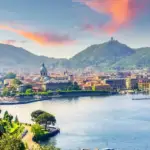






From March 18 to June 18, 2023, Palazzo delle Paure in Lecco hosted “FUTURISTI: Una generazione all’avanguardia” (Futurists: An Avant-Garde Generation).
The exhibition explored the innovative artistic movements that emerged in Italy during the early decades of the 20th century. In particular, it focused on Italian Futurism through works by some of its most influential artists.
These included Giacomo Balla, Luigi Russolo, Gino Severini, Enrico Prampolini, Filippo Tommaso Marinetti, Antonio Sant’Elia, Fortunato Depero and Tullio Crali, alongside many others.
Futurists Exhibition and “Percorsi nel Novecento”
The exhibition was the second of five events in the “Percorsi nel Novecento” (Journeys Through the 20th Century) programme.
The Direzione del Sistema Museale Urbano Lecchese, together with the Municipality of Lecco, developed the initiative.
Meanwhile, ViDi Cultural was responsible for planning and organising the exhibitions.
The programme continued until November 2024, exploring Italian cultural developments during the first six decades of the 20th century.
Italian Futurism: The Exhibition
Curated by Simona Bartolena, the exhibition examined the revolutionary influence of Futurism on Italian art and society.
The movement introduced new ideas not only in visual arts but also in literature, music and everyday life.
Furthermore, the exhibition explored the different expressions of Futurism and its connections with European artistic movements.
Through paintings, experimental works and historical references, visitors discovered one of Europe’s most important avant-garde movements.
Futurists Exhibition: Seven Thematic Sections
The exhibition was divided into seven chapters, offering an overview of both famous and lesser-known aspects of Futurism.
1. The Origins of Futurism
The journey began on February 20, 1909, when Filippo Tommaso Marinetti published his manifesto, Le Futurisme, in the French newspaper Le Figaro.
Through provocative language, Marinetti called for an artistic revolution.
His goal was to reject traditional ideas, which he described as “passatismo”, and make room for modernity and innovation.
2. Futurism and the First World War
The exhibition then explored the relationship between Futurism and World War I.
At the time, many Futurists supported intervention in the conflict. They believed that an imperialist policy could improve Italy’s national position.
In addition, a painting dedicated to Francesco Baracca by Plinio Nomellini offered an opportunity to examine the relationship between Futurism and Divisionism.
3. Futurism and Cubism
Another section focused on the development of new experimental artistic languages in the early 20th century.
In particular, it explored the connection between Futurism and Cubism.
The exhibition highlighted Gino Severini, whose work created an important link between the two artistic movements.
4. Futurism and Abstract Art
The exhibition also investigated the emergence of abstract art in Italy, a subject that has received relatively limited attention.
Works by Giacomo Balla illustrated the movement’s experiments with abstraction.
Moreover, a special focus examined artists from Como, including Manlio Rho, Mario Radice and Carla Badiali.
Their artistic research and relationship with Marinetti offered further insight into the development of Italian abstraction.
5. Movement and Dynamism in Futurist Painting
One of Futurism’s most innovative features was its attempt to represent movement through painting.
Artists experimented with compositions that suggested motion, energy and transformation.
As a result, their works created what the Futurists called “dynamic sensations”.
Paintings by Luigi Russolo, Roberto Iras Baldessari, Giulio D’Anna and other artists illustrated these ideas.
In particular, the artworks explored dynamism, simultaneity and the overlapping of visual planes.
6. A Futurist Universe: Art, Design and Music
The section “Un universo futurista” (A Futurist Universe) formed the central part of the exhibition.
It explored how Futurism influenced applied arts, advertising, design, theatre, dance and music.
Special attention was dedicated to Fortunato Depero and his collaboration with Campari.
Furthermore, visitors could discover the experimental musical instruments known as “Intonarumori”, created by Luigi Russolo.
These innovative instruments reflected the Futurists’ interest in modern sounds and new forms of artistic expression.
7. Aerofuturism and Cosmic Visions
The final section examined the evolution of Futurism and the emergence of new artistic directions.
Among these, Aerofuturism developed from the fascination with aviation and the experience of flight.
At the same time, the movement explored a “cosmic” vision, influenced by spiritual and esoteric ideas.
Works by Tullio Crali, Gerardo Dottori, Giulio D’Anna, Fillìa, Thayaht, Alessandro Bruschetti and Barbara illustrated these different approaches.
Together, they demonstrated the diversity and evolution of Futurist artistic research.
The exhibition catalogue was published by Silvana Editoriale.
Information and Contacts
Opening Hours
- Tuesday: 10:00 AM – 2:00 PM
- Wednesday to Sunday: 10:00 AM – 6:00 PM
- Monday: Closed
- Special opening: Easter Monday
- Closed on Easter Sunday and May 1
Admission Tickets
Full price: €10.00
Reduced price: €7.00 (visitors aged 13–18, visitors over 65, university students with valid ID, organised groups of 8–20 people, and FAI and TCI members with valid membership cards)
Special Trenord reduced ticket: €7.00 on weekends and public holidays; €6.00 on weekdays
Schools and children aged 6–12: €4.00
Free admission: Visitors with disabilities and one accompanying person, accredited journalists, licensed tour guides, children aged 5 and under, ICOM members, Abbonamento Musei Lombardia members, one accompanying person for every 15 group visitors, and teachers from schools in Lecco
Information
Tel. +39 0341 286729
Email: palazzopaure@comune.lecco.it
Websites: Musei Lecco | ViDi Cultural
Reservations for Guided Tours with the Curator, Groups and Schools
Email: prenotazionimostrevidi@gmail.com
Cover artwork: Roberto Marcello Iras Baldessari, Motociclista e città, 1916, pastels on paper. Private collection, courtesy of Leo Galleries, Monza.
This post is also available in: